Walter Furst
William TellWalter Furst is one of the leaders who turns resistance to tyranny into a collective political undertaking. He offers a meeting place, helps divide the work of organizing Uri, Schwyz, and Unterwalden, and grounds their claims in a distinction between imperial protection and local self-government. His authority is expressed not through personal ambition but through coordination, mutual obligation, and an insistence that resistance go no further than necessary. At the end, that same measure shapes his response to the death of the ruler: freedom from a forced duty does not require triumph or revenge.
Identity and Political Setting
Furst is introduced as the owner of the house in which a council scene takes place. He and Arnold of Melchthal enter simultaneously from different sides, placing Furst at the center of a gathering whose participants are arriving to deliberate together. The setting is practical as well as symbolic: political opposition takes shape in a household, among people assembled to work out what their communities can do.
Furst’s political argument emerges from the cantons’ account of their relationship with the empire. The communities, he and the other speakers maintain, had freely sought the Holy Roman Empire’s protection; that arrangement did not erase their right to govern themselves. Their people had kept their freedom and had not bowed to princes, while still recognizing an imperial authority above them. The distinction matters: Furst’s case is not that every form of higher authority is illegitimate, but that protection and judgment cannot be used to justify arbitrary rule.
The account of local law makes that distinction concrete. At home, the communities had governed themselves peacefully under their own laws and ancient usages. The emperor’s stated judicial power was confined to adjudging the penalty of death, and he appointed a powerful noble as his delegate. Against this constitutional background, the abuses of delegated rule appear as a violation of a limited arrangement, not as proof that the communities had never accepted any superior authority. Furst’s position belongs to a layered political order in which imperial obligation, local custom, and communal decisions all matter.
Organizing the Resistance
When the speakers ask what course could secure success, Furst frames the objective as shaking off a hated subjection while preserving the communities’ ancient rights. His formulation links resistance to restoration: the purpose is not expansion or a new claim to dominate, but the protection of rights already treated as theirs. That limit is central to his political character. His answer is forceful, but it is directed toward a defined end.
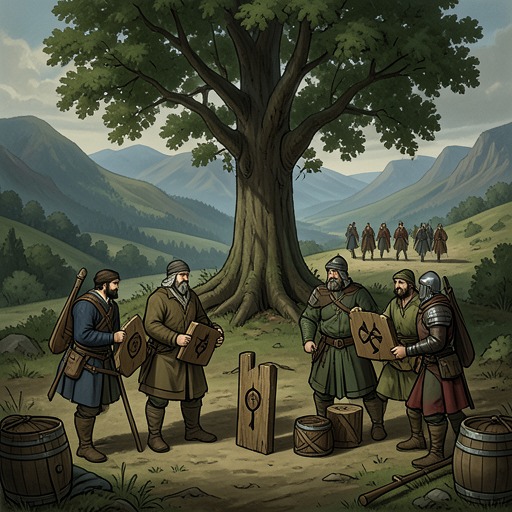
The organizing plan distributes responsibility among the cantons. The men of Schwyz are to be roused, Furst undertakes to rally friends in Uri, and the speakers still have to determine whom to send to Unterwalden. The plan makes the uprising a coordinated effort rather than the action of an isolated avenger. It also reveals the work behind collective resistance: separate communities must be reached, their supporters gathered, and the question of representation settled.
Furst’s role extends from planning to the structure of leadership. When the group resolves that Uri shall lead in battle and Schwyz in council, Furst gives Werner Stauffacher his hand and tells him to take his place. The gesture makes agreement visible. Leadership is assigned by function, with military and deliberative authority distinguished, rather than concentrated in one person. Furst’s contribution is therefore both organizational and constitutional: he helps form an alliance and accepts a division of its responsibilities.
The Three-Canton Pledge
Furst states the basis of the alliance in collective terms: the three cantons are pledged to one another to drive the tyrants from the land. His answer to the question of who will deliver the people is that they must deliver themselves. The emphasis falls on mutual commitment, not rescue by an external ruler. In this formulation, the league is an undertaking among communities that share both a danger and an obligation to act.
The proposed measures are severe. Furst says that the tyrants and their dependents will be driven out and their towering strongholds razed. Yet he also draws a boundary around what the alliance will do: whatever necessity requires will be done, and nothing beyond it. The contrast between destruction of the instruments of domination and refusal to go further gives his resistance a deliberate restraint. He does not present force as an unlimited license; its legitimacy depends on its purpose and extent.
The play later identifies a bond among the men of Uri, the community of Schwyz, and the people of the mountains of Unterwalden. Furst’s organizing work anticipates that written communal framework. The pact is not merely a declaration of shared feeling: its language identifies the participating communities, while Furst’s earlier actions show how their cooperation is assembled—through assignments, personal agreement, and a common undertaking against tyranny.
Authority, Death, and Restraint
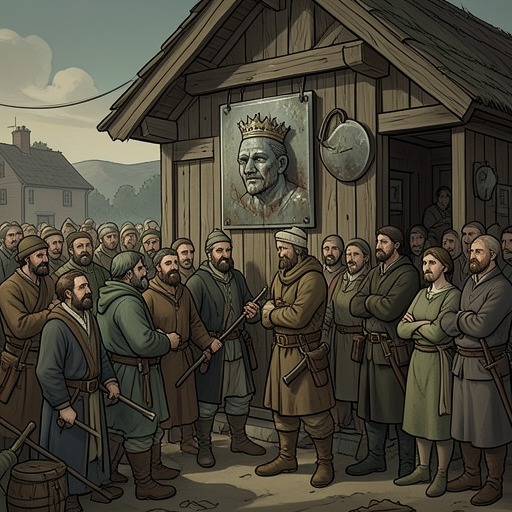
Furst remains part of the political community when a courier brings a letter from the queen. The assembled people ask him to open and read it, giving him the public task of receiving a message addressed to the men of Uri, Schwyz, and Unterwalden. The moment places him in a role distinct from his earlier organizing: he now mediates communication between the community and a bereaved ruler. The letter’s appeal is heard in a gathering already transformed by the death of the queen’s husband.
Furst refuses to make that death an occasion for celebration or a renewed recitation of past injuries. He says that the community will not triumph in the ruler’s fall or call its wrongs to mind. This response does not deny the oppression the cantons have suffered; it rejects the use of the dead man’s fate as a pretext for vindictive feeling. The decision gives ethical force to the restraint he had earlier expressed in political terms.
His reasoning rests on the difference between freely chosen allegiance and enforced duty. Love, he argues, must offer its obligations freely; death releases people from duties that were imposed on them. The dead ruler’s authority can no longer bind them, but that release is not an invitation to avenge themselves. Furst thus holds together two claims that might otherwise be confused: the cantons are no longer bound to the dead ruler, and they are not therefore bound to hatred.
Narrative Role and Significance
Furst’s importance lies in connecting inherited rights to collective action. He helps make a political case for autonomy, assigns practical tasks, endorses a division of leadership, and speaks of the three cantons as mutually pledged. At each stage, the emphasis is on a community capable of acting for itself, but answerable to the limits it sets for its own action.
His conduct also supplies a moral counterweight to the violence of liberation. The strongholds may be razed and the tyrants expelled, yet Furst’s insistence on doing no more than necessity requires prevents resistance from becoming an unbounded claim to vengeance. After the ruler’s death, the same principle takes a different form: release from compulsory obedience is not hatred freely chosen. Through Furst, the drama presents political freedom not simply as the removal of an oppressor, but as the capacity to govern collective power and obligation with restraint.